Have you ever looked at your transit chart, seen something major like Pluto crossing your Ascendant, and… felt absolutely nothing?
Or maybe you see a “good” transit, like Jupiter trine your Venus, and you sit around waiting for a check in the mail or a new romance, but all that happens is you buy a slightly expensive pair of shoes.
Predictive astrology is frustrating.
We memorize keywords. We know that Saturn means “restriction” and the Moon means “emotions.” But when we try to mash them together into a sentence that describes real life, we often end up with word salad.
“Okay, so… restricted emotions in the… 5th house? So, sad creativity?”
It feels flat. And usually, it’s wrong.
If you struggle to turn astrological keywords into clear, accurate predictions, it’s not because you don’t know enough astrology. It’s because you are likely missing the most important piece of the puzzle: The Outcome.
The Anatomy of a Prediction
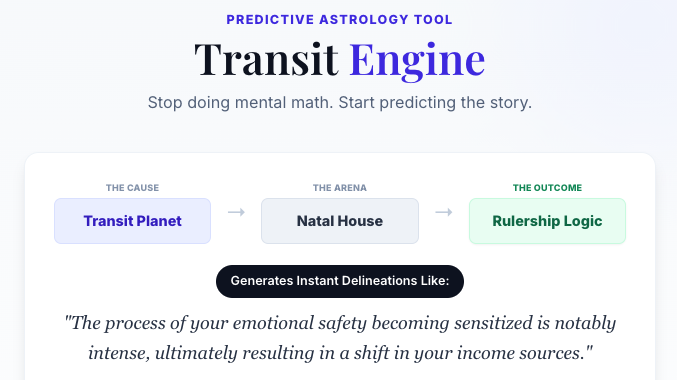
Most astrology apps give you two-dimensional data:
- The Cause: The planet in the sky (e.g., Mars).
- The Effect: The planet in your chart (e.g., Mercury).
They tell you: “Mars is heating up your Mercury. You might speak angrily.”
But that’s incomplete. To get the full story, you have to look at Rulerships. Every planet in your chart has a job—it “rules” a specific house. When that planet gets hit, the house it rules also feels the impact.
Let’s look at that Mars/Mercury example again.
- The Event: Transiting Mars hits your Natal Mercury.
- The Feeling: Your mind races, you feel argumentative.
- The Missing Link (Rulership): If your Natal Mercury rules your 10th House of Career, this isn’t just an argument. This is a workplace conflict that could change your professional reputation.
Suddenly, the prediction goes from a vague feeling to a concrete event.
Stop Doing Mental Math
Synthesizing the Planet, the House, the Aspect, and the Rulership in your head is hard. It’s a lot of mental gymnastics, and it’s easy to get stuck.
I realized I was spending too much time staring at charts and not enough time synthesizing the story. So, I built a tool to help me with it.
Introducing the Transit Engine
I created the Transit Engine to be a “calculator” for astrological logic.
Instead of guessing, you just plug in the ingredients:
- The Transit: Saturn in the 4th House.
- The Natal: Moon in the 1st House.
- The Aspect: Square.
And the engine instantly generates the delineation for you. It separates the transit into four clear layers:
- The Shift: The actual event or energy change.
- The Feeling: The internal psychological experience.
- The Concrete Manifestation: The immediate apparent impact
- The Outcome: The concrete result based on the house rulerships (the step everyone forgets!).
See It In Action
I ran a quick test on a common transit: Transiting Saturn square Natal Sun. In this example, Saturn is transiting the 1st House, the Sun is in the 10th House and rules the 5th house.
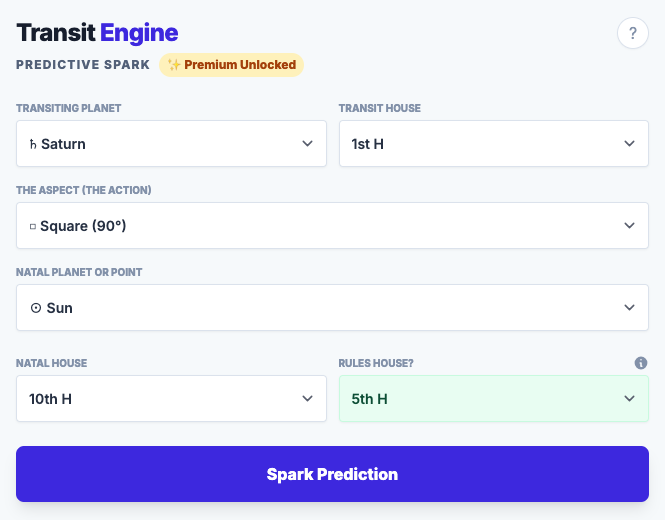
Here is the “Spark” the engine generated:
THE SHIFT: “A call to duty, born from a personal decision, is now blocking the path of your purpose.”
THE FEELING: “You are sensing demanding energy as your purpose becomes crystallized.”
CONCRETE MANIFESTATION: “Look for changes regarding your career path as the stage for this event.”
THE OUTCOME: “The final ripple effect involves a change in how you seek pleasure.” (Because the Sun rules the 5th House in this example).
It takes the abstract and makes it actionable.

Try It Yourself
I’ve made the Transit Engine available as a simple, lifetime-access tool. You can save it right to your phone’s home screen, so the next time you feel a shift in energy, you can pull it up and see exactly what is happening in seconds.
It’s perfect for students who want to learn how to sentence-build, and for pros who want a brainstorming partner.
Click below to see the tool and start generating your own predictions.